Showing posts with label light. Show all posts

Friday, February 11, 2011

ROY G BIV Video, Song, Book, and Craft (Rainbows)

Science and Music

White Light is really made up from a group of colors called the SPECTRUM.
The colors of the spectrum are red, orange, yellow, green, blue, indigo, and violet.
An easy way to remember this is to remember the ACRONYM, "ROY G BIV". Each letter stands for one of the colors in the spectrum.


Here is a cute little song and video about the color spectrum and ROY G BIV. (It's a hit with the kids!)

Click Here: ROY G BIV Video and Song


Arts and Crafts Follow-Up

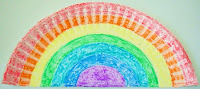
Have the kids draw and color their own rainbow using the 7 colors of the spectrum. Drawing paper or white paper plates (cut in half) with some crayons, paints, or markers should be enough to get the kids started.
(For younger kids, the teacher may have to draw the rainbow, then help the kids choose the correct colors.)


clipart by www.graphicsfactory.com


Instead of using crayons, I've seen some students use paint, colored cheerios, or small squares of colored tissue paper glued on the paper plates. :)

Children might even surprise you when you give them some sidewalk chalk. They may draw you a picture like the following when at the park or at outdoor recess.


Katie at Sergeant Major Mom's Blog made an AWESOME Layered Rainbow Cake. Here is a link to her post.
Click Here: Katie's Layered Rainbow Cake


Language Arts

A book for children on this topic is The Magic School Bus Makes a Rainbow, A Book about Color(Have you met Ms. Frizzle?)


MATH Extension Activity

To add a math activity to this theme, students could tally and graph their favorite color!


Have fun learning about rainbows!


Tuesday, February 8, 2011

Reflected Light

How does light help us see things?


  • Light must have a source (Sun, flashlight, lamp, etc.) for us to see anything!
  • Light can be reflectedReflection means to bounce off an object.
  • The reflection of light on an object is what allows us to see an object.
  • The reflected light enters your eye and an image of the object forms at the back of your eye. This image is sent to your brain and then you see the image of the object.
  • Reflected Light makes it possible to see yourself in a mirror.


Activity

  • Have children use a mirror to see their reflection.
  • Have them wink their right eye. Ask: "Which eye in the mirror winked?" (left eye).
  • Have them wave their right hand. Ask: "Which hand in the mirror waved?" (left hand).
  • Have them hold up a book, piece of paper with their name, or other writing in front of the mirror. Ask the children how the writing looked.
  • Help the children understand that the image is always reversed.
  • Ask the children if they can think of any other times that they saw their reflection other than using a mirror. ( Possible answers: in a clear, calm pool of water, on a glass door, on the side of a shiny toaster, in a spoon, on a television screen, etc. ) 
  • Ask the children what all these things have in common?  (They all are smooth flat surfaces.)  
        Smooth, flat surfaces reflect light best!

Download a FREE Light Energy Word Search Puzzle at my website for your students! Click on Science Worksheets.

                   https://www.LearningWorkroom.com

LIGHT ENERGY WORKSHEET


Have fun teaching science!!!


Monday, February 7, 2011

What Causes Shadows?

What happens when light is blocked by an OPAQUE object?


Materials
  • flashlight or other light source
  • opaque object

Directions
  • Have students PREDICT what will happen when light is blocked by an opaque object.
  • Shine a flashlight or other light source on the wall.
  • Choose an opaque object to put in front of the light source to block the path of light.
  • OBSERVE.  (A shadow should form.)
  •  Have the students RECORD their observation(s) in their science notebooks.
 
    Other Activities
      • This same activity can be done outside using the Sun instead of a flashlight!


      • Children may enjoy making animal shadows on the wall/ground.
      • A nature walk on a sunny day is also fun to observe shadows in nature. (Trees make great shadows!)

      Friday, February 4, 2011

      Transparent, Translucent, and Opaque Materials

      What happens when LIGHT hits an object?


      Three (3) things can happen.
      • Light passes through easily (if the object is transparent)
      • Light is blurred (if the object is translucent)
      • Light is blocked (if the object is opaque)

      Materials
      • Transparent object(s) {clear plastic cup, glass, water, etc.}
      • Translucent object(s) {some tinted plastic cups, waxed paper, sunglasses, etc.}
      • Opaque object(s) {some plastic cups, aluminum foil, cardboard, etc.}
      • Flashlight 
      • Plastic plate (optional)

      Experiment
      1. Show the children 3 different objects (1 transparent, 1 translucent, 1 opaque).
      2. Have the children predict what will happen when they shine a light on each object
      3. Have the children shine a light on each object, observe what happens, and sketch a picture of what happens and/or record their data in their science notebooks.
      transparent (air)

      transparent (cup)

         transparent (cup and water)


        translucent (cup)


        opaque (cup)

        FOLLOW UP ACTIVITIES

        For a follow up arts and crafts activity children can use their (recycled ) materials and make a  "Light" mobile to hang. They can look for other lightweight transparent, translucent, and opaque objects to put on their mobile.

        Download a free Light Energy Word Search Puzzle at my website! Click on Science Worksheets.

                           https://www.LearningWorkroom.com


        For more Light Energy Activities, click the link below.


        If you are teaching a unit on light energy you might like to view my illustrated LIGHT ENERGY WORD WALL CARDS at my TPT shop.

        Click HERE


        HAVE FUN TEACHING SCIENCE! 


        Wednesday, February 2, 2011

        Does Light Travel in a Straight Line?

         Learning Concepts
        1. Light travels in a straight line.
        2. When something blocks the path of light a shadow is formed.

        Materials 
        • flashlight
        • 3 index cards with a hole punched in the center of each card
        • something to hold the 3 cards upright (I used 3 clips) 
        •  


          Directions
          • Stand the cards up a few inches apart on a flat surface. (Line up the holes.)
          • Shine a flashlight from one end through all the holes.
          • Did the light travel through all the holes?
          • Move the middle card a little so the hole is not lined up.
          • Shine a light through the holes.
          • What happened?
          • Did the light travel through all the holes? 
          • Does light travel in a straight line?
          • What happens to light when it is blocked?
          • How is a shadow formed?
          Download a free Light Energy Word Search Puzzle at my website! Click on Science Worksheets.

                             https://www.LearningWorkroom.com

          Light Energy Word Search Puzzle


          Have fun teaching science!


          Tuesday, February 1, 2011

          Sun Song and Craft Activity

          Our Sun is the brightest natural light source that we have.
          Caution children NOT to look directly at the Sun and to wear sunglasses on sunny days!


          Here is a Fun Sun Song to learn more about the Sun.

          Click here: Sun Song


          clipart by www.graphicsfactory.com


          Arts and Crafts Activity


           Make a Sun Print

           Materials

          • dark construction paper
          • flat objects
          • a sunny day!

          Directions


          1. Put construction paper outside or in a very sunny spot (window sill).
          2. Arrange objects on paper.
          3. Wait a couple of days or longer, then remove items.
          4. The Sun should have faded all the paper that was not covered by the objects leaving the paper under the objects untouched.    


          Light Energy Introduction

          LIGHT is a form of Energy.

          LIGHT SOURCES are objects that make their own light

          • Ask children to brainstorm a list of Light Sources. (Sun, stars, light bulbs, car headlights, flashlights, fireflies, etc.)
          • Ask if they know of any light sources that we can not see (X rays, radio waves, microwaves) 

          Activity
          Can you see a light beam?

          Materials needed
          • flashlight
          • spray bottle filled with water
          • notebook
          • pencil
          Light Beam


          Directions
          1. Darken a room.
          2. Turn on the flashlight and aim it across the darkened room. Have the children observe.
          3. Ask students if they can see a light beam.
          4. Have students predict what will happen if they spray some water in front of the flashlight?
          5. Turn on the flashlight again and spray the water in the flashlight's path of light. Have the children observe.
          6. Ask the children to explain what they see. (They should see a beam of light.)
          7. Explain that the water reflects the light and that is why they can now see the beam of light.
          8. Have students draw pictures of what they saw before and after the water was sprayed in front of the lit flashlight.
          Download a free Light Energy Word Search Puzzle at my website! Click on Science Worksheets.

                             https://www.LearningWorkroom.com

          Light Energy Word Search


          Have fun teaching Science!


          LinkWithin

          Related Posts Plugin for WordPress, Blogger...

          LinkWithin

          Related Posts Plugin for WordPress, Blogger...